Showing posts with label breast cancer. Show all posts

Monday, 9 January 2017

How Does Food, Dietary Supplements and Physical Activities Associate with Our Health

Good morning friends, I would like to share what I’d learned from the health talk organized by National Cancer Centre Singapore, on 7th January 2017, about “Impact of food, dietary supplements and physical activity on cancer management”, shared by Ms Chang.

Based on study, the total number of cancer cases in Singapore does not showing any sign of decreasing throughout the years.


Top three cancer cases for male are colorectal, lung and prostate cancer.


While for the female, the top three cancer cases are breast, colorectal and lung cancer.


150 minutes of exercise per week are recommended for everybody regardless of your health.


From the study, it is clearly that dietary and food choices are associated with our health.


The recommended daily diet composition are:


There are 52% of adults in the US are currently on supplements, however, there are no significant improvements in cancer treatments, and may actually increase mortality!


Alcohol intake is linked to the risk of some primary cancers:


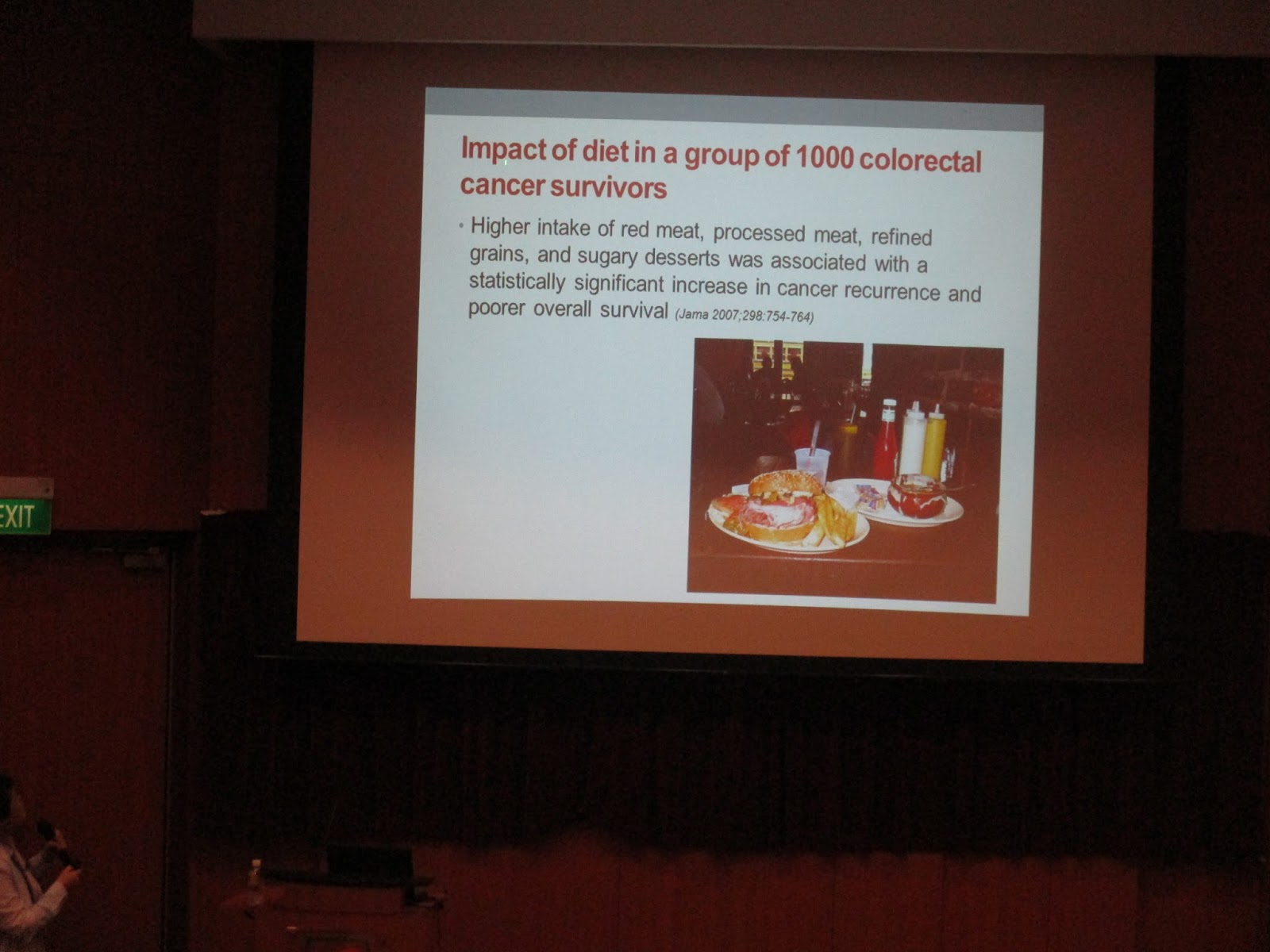
Red meat such as beef, mutton, pork, duck, and processed food has been link to cancer risk, especially colorectal cancer:


While reduction of red meat and processed meat could reduce the rick of colorectal cancer by 70%:


So, what's in actually inside of the red meat that causes it so harmful to our health?


Plastic has been related to hormone disruption:


From the study, increasing in fruits and vegetables intake will reduce the risk of getting cancer:


For full resolution of these photos and more photos about fats, cooking oil, Omega-3 and Omega-6, trans-fatty acid, processed food, etc, please click on the link below:

https://1drv.ms/f/s!AuULMyPlsElGjpo7gv8GL9Mqaa7L8g

Do you know what there are cancerous cells inside each one of us, however, it is depends on our immune system to destroy these cancerous cells while it is still not life threatening! A healthy immune system is the key to a healthy life!

How can we keep our immune system healthy? Nutritional Immunologist has the answer for this question:

http://nisuperfood.blogspot.sg/2016/09/nutritional-immunology-by-dr-jau-fei.html

What is Nutritional Immunology?

http://nisuperfood.blogspot.sg/2016/09/what-is-nutritional-immunology.html

Understand your immune system:

http://nisuperfood.blogspot.sg/2016/09/understand-your-immune-system.html

If dietary supplements are able to help to cure diseases, why till today, mortality rate still climbing high?


How do I consume 28 types of fruits and veggies in my daily meal? 


"Health is like MONEY, we never have a true idea of its value until we LOSE IT." John Billings

I wish all of you stay healthy and be cheerful, because, life is precious and beautiful.

Casper Teo
82183033
casperteo.ct@gmail.com


Wednesday, 19 October 2016

American Ginseng


American Ginseng (Panacis quinquefolis) root was once worth its weight in gold. Entrepreneurial Jesuit missionaries cultivated and exported the herb from North America to China in large amounts during the 18th century, selling it for an extraordinary profit. At that time, little was known about American ginseng except that Native Americans were using it to treat nausea and vomiting.

Initially viewed as a highly prized traditional medicine, the nutritional value of American ginseng root is gradually finding scientific explanation and credibility. It is packed with fiber, iron, magnesium, potassium, zinc, vitamin C, B vitamins, and other less common nutrients such as ginsenosides.

Ginsenosides
Ginsenosides are a group of phytochemicals that are present only in ginseng. They are the most active components of ginseng, and although they have similar molecular structure, they have different function. The amounts and types of ginsenosides in each type of ginseng vary, For example, ginsenosides Rf is present in Asian ginseng but not in American ginseng, and American ginseng has more Rb1 than Asian ginseng. It is possible that ginsenosides that appear to have no function help to make "active" ginsenosides easier for the body to absorb.

American ginseng extract contains more than 30 ginsenosides, including Rb1, Rb2, Rb3, Rc, Rd, Re, Rg1, Rg2, Ro, and F2. Of these, Rb1 and Re make up more than 75% of the total ginsenoside content in American ginseng. Rb1 is an antioxidant that can prevent ulcers, help the body to cope with stress, and increase rates of learning. It also enhances nerve regeneration.

In addition, Rb1, Rg1, and Rh1 acts as weak phytoestrogens in the body. Phytoestrogens are plant hormones that encourage healthy cell growth while inhibiting tumor growth. By binding to cells where human estrogen typically binds, phytoestrogens mimic the positive roles of human estrogen without harmful side effects. Hence, American ginseng has often been recommended for relieving menopausal symptoms.

Rb1 suppresses and Rg1 stimulates the central nervous system. Such combinations of opposing functions within this wonder herb contribute to American ginseng's use as an adaptogen that normalizes bodily functions to balanced states.

Wondrous Immunity-building Properties
American ginseng is not just an energy herb. It also helps to strengthen the immune system in a variety of ways, one of which results from its polysaccharides. Polysaccharides are long chains of sugars that help balance the immune system and enable tit to destroy existing cancer cells and viruses.

A study reported that polysaccharides in American ginseng may stimulate multitasking immune cells called macrophages to secrete cytokines, chemicals that summon immune cells to deal with bacteria and viruses. American ginseng also builds immunity by stimulating the production of tumor necrosis factor-alpha (TNF-alpha), an immune chemical used in fighting viruses.

American ginseng may be good news for people prone to colds. Researchers discovered that by consuming American ginseng root extract in a moderate dose over four months reduces the number of colds, the severity of colds, and the number of days they last, possibly preventing respiratory tract infection. Studies also show American ginseng to have potential protective effects against breast and ovarian cancers.

Completing the Package with Antioxidant
There is more antioxidant activity in American ginseng than in Asian ginseng. The free-radical scavenging activity of American ginseng can reduce oxidation of low-density lipoprotein (LDL), otherwise known as bad cholesterol. LDL that has gone through oxidation contributes to atheroclerosis, which may cause heart attacks. The antioxidant property of American ginseng can also slow down again because its antioxidants reduce free radical damage in some tissues.

Wednesday, 28 September 2016

Blueberry


Blueberries are tiny, but they are mighty, disease-fighting warriors. Brimming with health-promoting compounds, they provide a delicious boost to the heart, immune system, brain, eyes, and musculoskeletal system.

Boosting the Immune System
Cell damage caused by unstable oxygen molecules called free radical weakens the immune system. This damage is also linked to aging and chronic diseases like cardiovascular disease and cancer. Bluberries are nature's wonders, bursting with the goodness of antioxidants to protect the body by neutralizing free radicals. They are one of the richest sources of antioxidants, making them a powerful supporter of the immune system.

Based on data from the USDA Human Nutrition Research Center on Aging, blueberries are among the fruits with the highest antioxidant activity. Just 100g of fresh blueberries can deliver the antioxidant capacity of five servings of some fruits and vegetables.

Supporting Heart and Liver Health
Keep your heart happy with blueberries. Thanks to their high antioxidant activity, blueberries help reduce the buildup of LDL ("bad") cholesterol, thereby preventing cardiovascular disease and stoke. Resveratrol in blueberries has an anticoagulant effect that prevents the formation of blood clots that may block blood vessels and cause heart attacks and stroke.

Helping to Prevent Cancer
Blueberries contain more than 40 healthful compounds with high antioxidant activity that may reduce risk of certain types of cancer. Scientific research shows that pterostilbene in blueberries has immense potential in breast cancer prevention. Folate in blueberries may help guard against cervical cancer. Consuming blueberries may reduce liver cancer risk. Researchers found that phenolic acids and anthocyanins in blueberries inhibited the growth of liver cancer cells by 50%. Resveratrol and ellagic acid in blueberries have shown significant anticancer effects and may delay the aging process.

Protecting Brain Cells
A study in the Journal of Agricultural and Food Chemistry reported that one group of volunteers in their 70s with early memory decline drank the equivalent of 2-2.5 cups of a commercially available blueberry juice everyday for two months. A control group drank a beverage without blueberry juice. The blueberry juice group showed significant improvement on learning and memory tests. Another study showed that people who ate a cup of blueberries a day performed 5%-6% better on motor skills tests than the control group.

Blueberries are rich in quercetin. Quercetin has been found to be particularly effective in protecting brain cells from free radical damage that can lead to dementia. One study published in the Journal of Agricultural and Food Chemistry found that quercetin protected rats' brains from damage due to exposure to hydrogen peroxide, a free radical.

Research at the University of Reading has found that phytochemical-rich foods, such as blueberries, can reverse age-related memory decline and may have implications for the treatment of diseases associated with age (such as Alzheimer's disease). Published in Free Radical Biology & Medicine, that research shows that supplementing a regular diet with blueberries results in improvements in memory.

Improving Vision
Individuals who spend long periods staring at computer screens should eat more blueberries. According to Japanese research, blueberries ease eyes fatigue and improve weak eyesight. Blueberry consumption increases circulation of the capillaries of the eyes, which reduces oxidation in these tissues. This action benefits eyesight. It is thought to be especially helpful in preventing diabetic retinopathy, a disease of the retina due to diabetes mellitus, as well as night blindness, cataracts, and macular degeneration, an age-related eye disease that is the leading cause of vision loss in the elderly.

Fortifying Bones and Muscles
Blueberries contain manganese, an essential trace mineral important for many chemical reactions in the body. Manganese also aids in keeping bones strong. Studies show that malvidin glycosides in blueberries may be beneficial in alleviating muscle damage caused by oxidative stress. Blueberries contain flavonoids, which help strengthen connective tissue.

Anti-allergy Effect
Blueberries reduce the production of histamines, which are the inflammatory substances the body produces that are responsible for allergy symptoms.

Promoting Urinary Tract Health
Research shows that phytochemicals in blueberries called proanthocyanidins prevent urinary tract infections by inhibiting E.coli bacteria from adhering to the walls of the urinary tract.